Showing posts with label Birds. Show all posts


Quaker Parrota medium birds, which makes an excellent pet. They are the best speakers from all secondary birds and relatively inexpensive. Quaker will require considerable time and effort though.
Quaker parrots in South America, also known as Quaker parrots. They are mainly in Brazil, Paraguay, Argentina, Uruguay and Bolivia. But today there are still some Quakers living in the United States. Wild animals living in the United States escaped from the birds that lived there. There are many Quaker parrots living in Florida.
Quaker eleven inches in length and weighs from 90 to 120 grams is the size of a parrot, but much more compact. The predominant color of green birds, but other mutations, such as albino, Harlequin, cinnamon, lutino cinnamon and blue. They also have beautiful blue and green tail feathers. His attention is clear or yellow horn.
In some places, Quaker parrots are illegal, make sure you can try before you reach home. They are prolific breeders and birds run, they can form very large populations. This could be the problem why some states have laws against it. United States, where they are illegal, California, Tennessee, Kentucky, Wyoming, Rhode Island, New York and Hawaii.
It is important that you put the bird a good diet to stay healthy. The diet should be granular seed. Other products such as vegetables, fruits, bread and cereals should also be offered. Variety is always good on a diet. You should not feed a large number of seeds. Some things you should never have caffeine, chocolate, alcohol, and avocado. These are toxic to all species of birds. Food and water should be in a cage all the time.
The minimum size cage for Quaker is 18 cm long and 18 cm wide and 24 inches. Try to get the biggest cage you can help your bird. Some Quakers are usually in their territorial space in cage. As a rule, you may do so in order to avoid a "gap" in the cage. Sleeping box works very well for him. You should also see many different types of toys that your bird busy.
You must keep your bird's wings trimmed and cut nails. Almost all Quakers also love baths. Just fill the container about inches of water and let your bird a bath. Try to bath water as often as possible. At least, you should stop taking a shower once a week. It really helps your skin and feathers, and fun for your bird.
Quakers are very sweet bird who always want to be with you. They are very loyal to their owners and playful, but also stubborn. You have a wonderful ability to speak and very entertaining birds.
Be careful before buying Quaker parrot, noisy birds. They love the noise and what makes them so good speakers. Saying that it is not only sound but. They often make squeaking sounds that can be very annoying.
Quakers in the best home to spend time with them. You must understand that these birds require a lot of love and attention. Make sure the bird you want before you begin

Barn Swallows Come to Roost

Posted by radaz212 | 1:13 AM


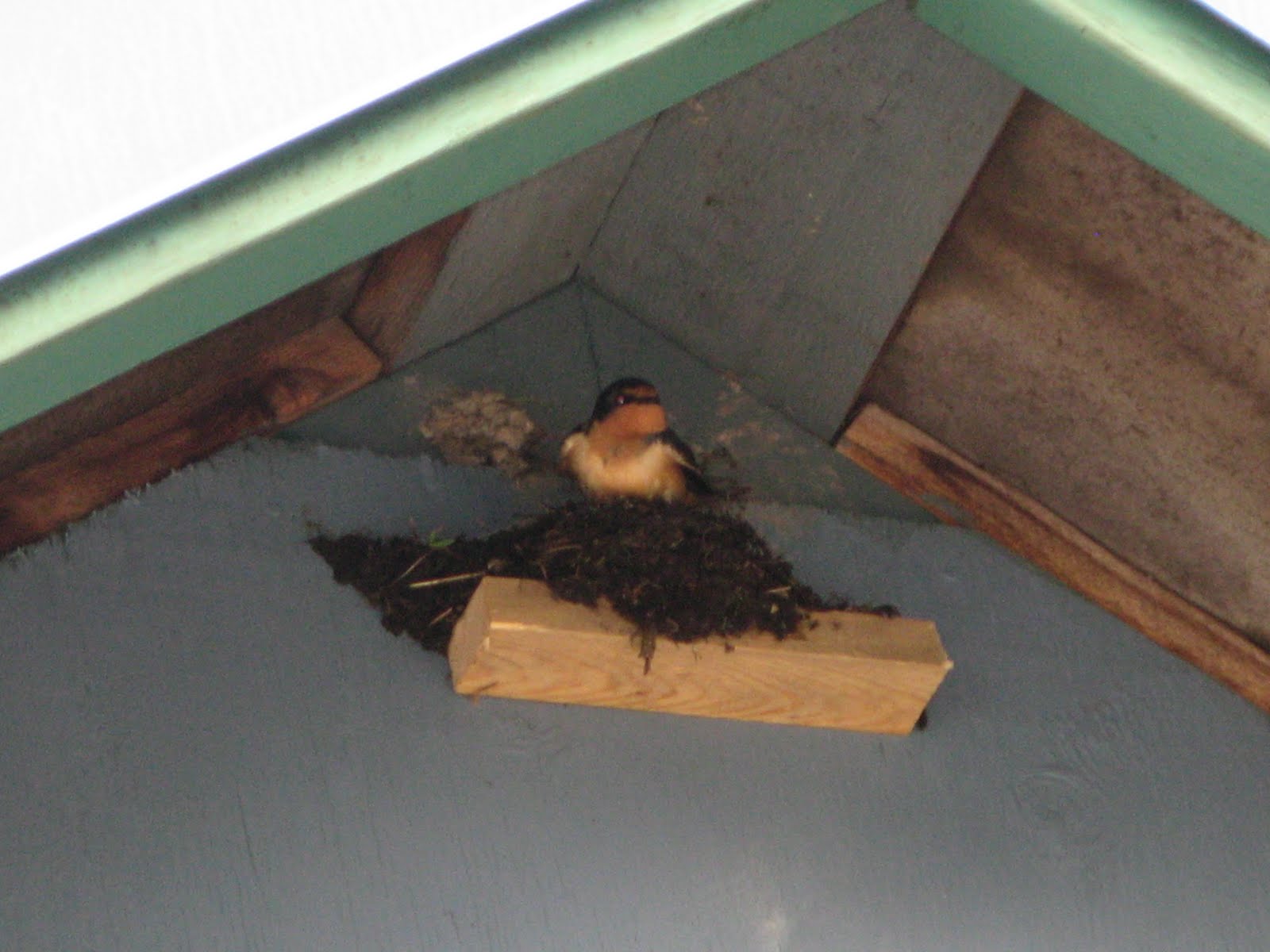
We were pleased to see a pair of Barn Swallows return this year to build a nest under the peak of our roof. Last year's attempt had a disastrous end. After a week of building, the nest fell and the pair disappeared for the remainder of the season. I don't know if it is the same pair, but somehow I hope so.

I know Barn Swallows build mud nests in some locations, but here it is a mixture of mud and grasses. They pick the most precarious spots to build their nests. The one under our roof has no support other than a 1/2 inch ledge of wood near the eves. Somehow they are able to concoct a substance sticky enough to hold everything up straw by straw.

The female bird is now sitting on her nest. Hopefully there will be young chicks soon that we can watch grow and someday take to the skies like their acrobatic parents. -- Margy

Up until this year I’ve been thrilled when the Canada Geese come through showing off their new babies. But it is different this year. That’s because they finally discovered my floating garden. My short fence was no match for their desire to feast on my fragrant strawberries and luscious lettuce.

It has been doubly disappointing since the plants in my floating garden have been struggling this year. What the geese didn’t devour, they trampled with their big feet and heavy bodies. The “babies” are almost adult size already.

When I see them paddling through, I run out to protect what is left. They nonchalantly head on over to one of our garden logs on the breakwater and eat their fill. If geese had thumbs, I’m sure they would be giving me the high sign.

Next year I will need to rethink my garden fence to a sturdier, higher model. But will also need to be a removable one so that I can work and pick when they aren’t nearby. Does anyone have any suggestions? -- Margy

The baby birds have flown the coop. We returned to the cabin last week and saw both broods still snug in their nests.

A Violet-Green Tree Swallow baby had his head sticking out of the hole of the birdhouse on our shed. Mom and Dad were busy flying sorties with tasty bugs for his (by now) big mouth. Then the next morning, no one was left at the nest. I don’t know how many babies there were since only one at a time was visible. Unfortunately, we missed the takeoff.

Up above at the peak of the cabin, two large babies were visible in the Barn Swallow nest. Again, the next morning both were out flying. Unlike the tree swallows, the Barn Swallow babies are still hanging around. They like to perch under the porch, on the garden float and on our many floating log stumps. They are so much fun to watch.


Meanwhile, Mom and Dad are busy readying the nest for another brood. They rebuilt the sides to make it larger. Now Mom is sitting again, and Daddy Bert is singing his heart out to his lovely lady and taking some time out for a little home-grown fun.

That is, when he isn’t out amusing himself on the playground equipment. -- Margy

Last May, I shared how Wayne and I were giving our Barn Swallows a helping hand with their nest building. Older nests have fallen twice, so we gave them a little shelf up under the eves to use as a support.

In June, I shared about how the returning pair immediately set up housekeeping and started a new nest. Last week we saw the heads of two babies. Both Mom and Dad bring tasty bugs back to their fast growing chicks.

We call daddy Bert. He's a slim dude. When he isn't eating and gathering bugs for his babies, he sits nearby and seranades his lovely lady on the nest. I have read that pairs mate for life. I like the thought of Bert and his Lady coming back each year to share their babies with us.

Do you have nesting birds that you like to watch? For us, they provide hours of enjoyment. -- Margy

The other day, Wayne and I heard the cry of a loon, but it didn't sound just right. Where we live, the typical species is the Common Loon. At a distance, the body shape was the same. But as he came closer, I noticed a big difference in the colouring.

The Common Loon is black and white. This bird was more gray and white, and had a brick red throat. I looked it up in my guide and discovered it was a Red-throated Loon.

I discovered the Red-throated Loon is not common in Coastal BC during summer months. They prefer the Arctic for breeding and return to our shores in the winter. I've seen two birds swimming side-by-side, so they might be a breeding pair. Is this a result of our cool start to summer? Whatever the case, I've enjoyed hearing the calls of our visiting Red-throated Loons and watching them ply the waters of Hole in the Wall. Has anyone else seen nesting Red-throated Loons this summer? -- Margy

On May 22, we gave our resident Barn Swallows a helping hand with their nest building by adding a wooden perch. At the end of the season last year, their nest fell onto the porch roof. Fortunately, the three chicks inside were ready to fly and survived.

This time, with the wood base Wayne provided, the pair has been building a new nest. Off and on all month both the male and female birds have been working, bringing in mud and plant material. But it's finally finished.

The female is starting to lay her eggs. And her mate has been spending a lot of time on the swim ladder singing to her. They are really a loving pair. It's going to be fun to watch the family grow throughout the summer. With a more secure footing for their nest, it hopefully will be a much safer one as well.

Do you have nesting birds to watch? -- Margy

It's been two years since I've seen a Brown-headed Cowbird. We were on a quad ride to Fiddlehead Farm and one was foraging in the grassy meadow while we had our lunch. This week one came to visit for the first time at our cabin. It bounced around on the rocky cliff and then stopped by my garden float for a brief rest.

The Brown-headed Cowbird are termed brood parasitic. They lay their eggs in another bird's nest and then abandon them for the host bird to raise as their own. Because they are a larger bird, this can be disastrous for the owner's chicks.

Cowbirds are a member of the blackbird family. They originally followed bison across the praries, but now have spread across North America. Their diet consists of seeds and small insects. Hopefully this one was keeping an eye on slugs and other pests, not the new seeds in my spring garden. -- Margy

For the last three years, Barn Swallows have nested under the peak of our roof. Last week the pair returned from their long winter trip to South America. It was so nice to have them back. I had a few questions and did a web search. The author of What's in My Backyard has compiled lots of good information. I wish I knew who the author was so I could give proper credit.

Life with us for the hasn't been easy. The first year their nest fell before they could even get a brood going. The next year they used the tattered edges of the old nest to build a new one and had a productive summer. Last year they returned, refurbished the nest and had two broods. All five of the chicks in the first one fell to their deaths on our porch roof. Then the nest fell at the end of the second round, but fortunately three of the chicks were ready to fly.

As soon as we knew they were back, Wayne and I decided to give Mother Nature (and our swallows) a helping hand. Barn Swallows are used to building their nests of mud, grass and feathers on vertical walls, but a little ledge doesn't hurt. Wayne installed a small wooden board just below the nest site from last year to give them a building platform.

I decided to try and help chicks that might fall. They say you can put one back in the nest if it survives the fall. I made a padded cushion out of an old sheet and some fiber fill. It will serve two purposes. Barn Swallow nests can be pretty messy. The little guys stick their bums over the edge to relieve themselves. It keeps the nest neat and tidy, but the surface below suffers. In addition to making a softer landing, the pad will keep our porch roof clean. At the end of the season it can go in the trash.

Barn Swallows take about a week or two to complete nest construction. Hopefully by the time we return to the cabin our pair will have set up housekeeping for a summer of fun and sun. -- Margy

This spring a new visitor came to the cabin. At first I thought it was a robin, but on closer inspection I identified it as a Varied Thrush.

It first appeared along the cliff, hopping from one grassy spot to the next, never close enough for a good shot.

A Varied Thrush is related to a robin. They live in the Pacific Northwest in wet, coniferous forests. They eat insects (probably a lots of those on the grassy outcrops this time of year), fruit and acorns. Logging of mature forests has limited their range. Maybe that is why he (she?) appeared near the cabin. They just harvested the hills behind us, maybe destroying it's natural habitat or nesting site. -- Margy

There's a famous town in Southern California called San Juan Capistrano. On March 19 (St. Joseph's Day) every year the Swallows return. They flock to the historic Spanish mission founded in 1775. They are Cliff Swallows and build mud nests.

Today, Hole in the Wall on Powell Lake started a new tradition. The first Violet-green Swallow returned. According to my bird watching log, last year the arrival date was also April 6. Do you think my cabin might become as famous as San Juan Capistrano? Maybe not, but I thought it was pretty amazing. What internal clocks these birds must have. The poor guy looked a bit bedraggled. Must have been a tough trip from Mexico or Central America.

Violet-green Swallows do not build mud nests like Cliff Swallows. They build their nests of grass tree holes or human constructed nest boxes. Several years ago we placed nest boxes around our cabin. We've enjoyed having at least one occupied each year. One of our older boxes needed replacing. Fortunately Wayne got it up over the weekend. I wasn't quick enough to get a picture, but they've already been checking it out. This new box has a hinged roof for easy cleaning at the end of the season. Oh, and there's even a rubber ducky for the kids to play with. Wayne thinks of everything! -- Margy

Last week I shared some sky photos of our ferry crossing to Mukilteo, Washington.

All the way across from Clinton to Mukilteo a flock of seagulls rode the wave of air rising off the front of the ferry. They were amazing to watch.

They would swoop low in front of the bow of the ship and then shoot high up in the air, bank around and do it all over again.

Wayne and I were mesmerized by their antics and wondered how they learned this behaviour. They caught a free ride all the way across from Whidbey Island to the Washington mainland. I'm sure they caught the return ferry run just for the fun of it. -- Margy

Early in July, I wrote about the tragedy that struck our Barn Swallow nesting pair in And Then There Were None. All five chicks were either pushed or fell to their deaths from their nest under the peak of our cabin roof.

On July 12, I wrote a Barn Swallow Update in which we built a "safety net" for future chicks. Shortly after, Wayne and I left for our vacation trip to Newfoundland. When we returned to the cabin last week, we were greeted by our nesting pair and the chirping voices of three new chicks. We were amazed at how big they were already.

The other thing we noticed was how crumbly the nest appeared. This is its second season, and the second brood this year. The dry weather and heavy use was really affecting its stability. Yesterday morning when I went out to check on the chicks, the nest had broken loose on one side. One chick was still clinging to the left side, but the other two were nowhere to be seen.

Wayne went up on the ladder, but there were no little bodies on the pad (thank goodness). The mother returned to the one chick several times. She would land on his back and give a nudge with both of her feet, like she was encouraging him to fly. After watching for a while, I went inside to cook breakfast. When I returned, the last chick was gone. The broken nest may have accelerated the three chicks' flying lessons, but it wasn't the disaster it could have been.

The family spent the morning soaring, gliding and dipping into the water for tasty insect treats. Later in the day, the three chick returned to the cabin porch to rest together. Then this morning, they ventured out as a team to the swim ladder. It has been lots of fun watching them. I hope Mom and Dad return next year and rebuild the nest, only a bit stronger this time. -- Margy

Wayne and I were so sad to see all five of the Barn Swallow chicks at our float cabin not make it. We thought maybe some of the first chicks to disappear were pushed out of the nest by their siblings (siblicide). But now we aren't so sure about that. The survival rate for barn swallows is quite good. The hatching success rate is 90% and the fledging survival rate is 70–90%.

The parents are very protective of their young. Both the male and female participate in nest building, incubation of the eggs and feeding the chicks. The day we returned to the cabin, I noticed one of the birds cleaning the nest. I hope it was the female getting ready to lay a second batch of eggs. To help any babies that fall might out of the nest, we've put some padding on the roof. It's worth a try.

When our pair of Barn Swallows aren't busy catching insects and raising babies, they like to sit on our swim ladder preening and singing to each other.


Hopefully their second brood of the season will end on a happier note. -- Margy

Last year a pair of Barn Swallows built a nest under the peak of our roof. Last year's nest was reoccupied this year. They say nesting pairs often return to the old nest, so maybe these are the same birds. Pairs typically are monogamous and the male is very protective of the female, fighting off any other male interlopers.

I know Barn Swallows build mud nests in some locations, but here it is a mixture of mud and grass. They pick the most precarious spots. The one under our roof has no support other than a 1/2 inch ledge of wood near the eves. Somehow they are able to concoct a substance sticky enough to hold everything up straw by straw. I've been watching our nest with binoculars and recording the developments on film.

On June 30 (the 1st shot), there were five chicks in the nest. Then on July 2 (the 2nd shot), there were only four. On July 4 (the third shot), the number had dropped, this time to three. One of the three was definitely smaller than the other two. Then on July 5 (the 4th shot), we were sitting on the front porch. We heard a loud thud on the tin roof. Wayne went up the ladder and found a chick below the nest. Further inspection led to the discovery of two additional dead chicks in the gutter.

We weren't sure what was happening. Was it sibling rivalry or were the chicks just getting too big and falling off the edge? After all, it's pretty precarious up there. It made us sad and a bit afraid that the mother bird might abandon the last two, but so far so good. Some web research indicates that barn swallows may lay their eggs asynchronously (over time) and start incubating the first eggs before the last are laid. This can result in larger siblings who are more aggressive and kill their "younger" and smaller siblings (siblicide). Not a very pleasant thought.

And that's not the end of the story. We returned to the cabin after a day in town. There were no chicks left in the next. We don't know what could have happened. Maybe the metal roof just was too unforgiving for their first flight.

Have you had any experiences like these? I'm curious what might have happened in the end. -- Margy

Wayne and I took our tin boat over to Chippewa Bay to meet our good friend John for a swim. John likes to swim in Chippewa because the water is warm(er) at the head of the wide bay. Because Powell Lake has been dammed, the water level has risen and submerged trees have become tall snags. On top of one snag is an osprey nest. As we were passing, we were surprised to see a mother bird take flight. We carefully backed away and sat quietly to observe the nest and her actions.

First she flew to a nearby snag and called her displeasure. Then she returned to the nest. Later she departed again. At first we weren't sure why, but then it was obvious. She rose high in the air and then made a running dive right to the water. At the last moment she pulled up and grabbed a fish in her talons. What a sight!

At one time, osprey numbers were declining, but fortunately they have made a comeback since the 70's. There are two nests that I know of on Powell Lake and another in the backwater area of Lois Lake. According to Birds of North America (National Geographic, 2006), the osprey can be identified by the distinctive colouring of dark brown above and white below, with a white head. It builds nests of sticks high in trees, poles, platforms and decks that are near fresh or salt water. Their diet is primarily fish.

We discovered one memorable osprey nest when we flew to the Dene First Nation village of Lutsel K'e on Great Slave Lake. You can read about it in Wayne's book Up the Airway. That particular osprey built her nest on top of the ADF (automatic direction finder) antennae at the airport. That essentially put the simple, but very important, piece of navigation equipment out of action until the chicks could fly. Good for chicks, hard on pilots. -- Margy

One of the earliest birds to arrive in Spring is the robin. It's a sign that summer isn't far away and a welcome sight. Now that it's summer, our visiting robin is all settled in.

She flits around the float and rock wall looking for tasty morsels. She especially enjoys foraging in my float garden for bugs and worms. I hate to lose any of my worms, but she is welcome to the bugs one and all.

The American Robin comes to vacation in Canada after winter is done and the weather starts to warm up. The robin is easily identified by its reddish-orange breast (Robin Redbreast), yellow beak and cheery song. I usually awaken (briefly) at dawn to her melodious song.

The robin's diet includes, of course, worms, other insects and even some snails. I wish she liked slugs, I've got more of those in my garden than I can count. Another favourite is fruit. When I go out to pick my strawberries there are always a few that have been eaten, leaving only a hollowed out shell. That's a small price for all the free bug eradication. -- Margy

I haven't been lucky enough to see any geese and goslings around our cabin in Hole in the Wall yet, but down at the Shinglemill Marina they are out in full force. A little over a week ago while having a brew and appies on the outside deck at the Shinglemill Pub, Mr. Hat and I saw two families paddle by.

The Canada Goose makes its nest near the water's edge. Pairs are known to stay together for life. Mating occurs in the spring on the water. A clutch of 2-8 eggs hatch in about a month and the chicks grow to sufficient size in 6-7 weeks to begin flying. By late summer, it is hard to distinguish the kids from their parents, except for the order of the procession on land or in the water.

During summer, the Canada Goose goes through molting. The flight feathers that are worn out from long migratory trips are shed leaving the birds unable to fly for up to 8-10 weeks. During this flightless period they prefer areas near lakes or ponds for security from predators. When geese gather in large numbers during the molting season it can be very damaging to local vegetation, not to mention messy. Fortunately, in the Hole we usually only get one nesting pair. We enjoy their presence and look forward to Mom and Dad showing off the kids as they grow. Hope that's soon!

Want to know more? See ...

Love Canada Geese
All About Birds
Ducks Unlimited Canada
Hinterland Who's Who
And there is a great movie about Canada Geese called Fly Away Home. It's about a thirteen year-old girl who raises and teaches a brood of orphaned Canada Geese to migrate using her father's ultralight airplane. A must see!! -- Margy