
 The Labour Day long weekend is coming soon! Powell Lake is very busy now and there's a cabin here just waiting for you. The water is warm, the sun is shining, and the BBQ in going. Don't miss out on what's left of the summer of a lifetime! There are still a few great properties available. If you have any questions or need us, you know where we'll be. Up the lake of course.
 Are you interested in getting a cabin of your own? Here's an updated list of cabins and properties up the lake that are for sale. Some are through real estate agents, so you can get more information via their websites.
 From the Powell River PEAK on September 1, 2010: Registered water lease ready for you to add the float cabin of your dreams. Prime location at the mouth of popular Henderson Bay with dramatic views of the Bunster range to the west and snow capped peaks to the north. Just 17 minutes from the Shinglemill Marina with a new breakwater and wind/solar power generation system on shore. Asking $45,000. For more information call 760-218-8938.
 Harry Zroback from RE/Max offers a float cabin on the south side of Goat Island just past Dego Point. It is a well appointed 3 bedroom, 2 bath float cabin. You have to take a look at the photos on Harry's website. It has lots of room for family and friends, or plenty of space for just the two of you. It comes with fridge, stove, woodstove, even satellite TV. The 60X60 cedar log float gives you lots of room to enjoy the outdoors and dynamite lake views. The asking price is $169,000. You can reach Harry at 604-483-8333 or harry@powellriverrealestate.com.
From the Powell River PEAK on August 27, 2010: Fully equipped float cabin for year round use. New fridge, stove, generator, composting toilet. Asking $115,000. For more information call 604-483-4293.
From the Powell River PEAK on August 27, 2010: Float Cabin, 2-bedroom plus loft (I love sleeping in our loft!). Propane refrigerator and stove (they work really well for us). Rainbow area. $100,000. 604-485-9374 From the Powell River PEAK on July 23, 2010 and online at ConsignAll.ca: Powell Lake float cabin 5 minutes past Hole-in-the-Wall, mainland side, 1-bedroom downstairs plus loft for additional beds, fully furnished including new propane fridge and stove, large float with lots of deck space and tie-up room, good breakwater and year-round stream, $120,000 firm. Contact Julie at 604-483-4293 or check online at ConsignAll.ca.
 Harry Zroback and Mandy Brown from RE/Max have a cute freehold cabin on Powell Lake. It comes with about half an acre of treed property about 15 minutes from the Shinglemill Marina. The 900 sq ft cabin has two bedrooms and one bath, and a cozy woodstove. It comes with canoe, linens, kitchen utensils, everything to get you started on the best summer you've ever had. All this for only $259,000. For more information, click here. You can reach Mandy at 604-485-2741 or mandybrown@remax.net. You can reach Harry at 604-483-8333 or harry@powellriverrealestate.com.
 From the Powell River PEAK on September 1, 2010: Warren Behan from Coast Realty lists a large float cabin on a large float now further reduced from $149,900 to $129,000. It is located in a scenic spot near the inlet of the Goat River. It comes with all furnishings. It's has a cozy wood stove, kitchen appliances including stove, oven, fridge and freezer, and bathroom with toilet and shower. Click here for more information, click here for a multimedia tour, or contact Warren at 604-483-8173 or warrenbehan@shaw.ca.
 Don Mcleod from RE/Max list a spacious boat access only float home in a beautiful and peaceful setting on Powell Lake's east side past the log dump and Dego Point now reduced from $84,000 to $79,000. It has a large deck, 3 bedrooms, wood stove in a spacious kitchen/living area plus a large loft. The listing says it has loads of room but needs finishing. Click here for more information or contact Don at 604-485-2741, by e-mail at don@mycoast.ca or his website www.mycoast.ca.
 Don Mcleod from RE/Max also has a land cabin on Powell Lake was listed for $140,000 but now it has been drastically reduced to only $79,900. The cabin is on it's own island (currently leased from the Crown/BC government) in picturesque Three Mile Bay, just three miles up the lake from the Shinglemill Marina by boat. It's an older cabin with a large kitchen and living room area. The floats do need work. What a perfect summer (or year-round) retreat great for swimming, fishing and just getting away. Large kitchen and living room area. Click here for more information about this great recreational property or contact Don at 604-485-2741, by e-mail at don@mycoast.ca or his website www.mycoast.ca.
 Interested in an 8.35 acre land holding for a remote retreat or ecotourism resort? The Powell Lake Lodge is for sale and Jason Zroback of LandQuest can help you out. The land has ten years left on a thirty-year Crown (government) lease. The improvements include five cabins, several outbuildings, water, septic and dock. It's been vacant for a while and would need some work, but the price is right at $299,000 for everything. It's water access from Powell River but there's road access to the ocean at Theodosia Inlet. Give Jason a call at 604-414-5577 or jason@landquest.com.
 Want a real estate agent that really knows float cabins? That's Harry Zroback (our man Harry who helped us get our cabin) from RE/MAX. Harry owns a cabin himself, so he's an excellent person to contact for all your "up the lake" real estate needs at 604-483-8333 or harry@powellriverrealestate.com.
If you have any questions about Powell River, Powell Lake or cabin living, I'd be glad to help out. Just leave a comment or use the e-mail link in my profile to send me a message. -- Margy
 Mom and "her cat" Stick Tail have been coming to visit us in Powell River for the last four years. We all pile into Mom's car, lovingly called Bertha, and take the short (about 240 kilometres) but long (two ferris and 7 hours) trip. Riding in a car isn't Stick's favourite thing (you can hear his protests from quite a distance), but he finally relaxes on the back seat, sleeping most of the way.
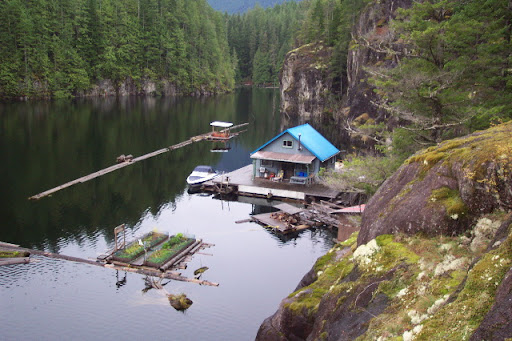
 The highlight of the trip north is visiting the float cabin. Stick has to stay in his carrier for the boat ride up the lake, but gets lots of comfort on Mom's lap. Once at the cabin, he settles right in. The beauty of the float cabin is that it is surrounded by water. Back in Bellingham, Stick has to stay indoors all of the time because Mom has an apartment style condo. But at the float cabin, he's able to have the run of the place.
  For Stick, the cabin is like a giant cat climbing apparatus. He loves the stairs (the first he has ever known) and gets a kick out of running up and getting a "birds-eye" view from the loft. At first, he was very cautious outdoors, but now he is comfortable in his vacation home. He even explores underneath the float (that's where the mousies live). One trip he did give us quite a scare. He hopped the floating logs to shore and started climbing our cliff. But a few good warning shots with rocks brought him scurrying for home.
 I'm always amazed at how quick Stick Tail adjusts to new environments. After only a few hours inside the cabin, he is allowed undisturbed exploration. Usually after one day he has a favorite sleeping place. And the litter box has always been found without any "accidents." A friend warned me that cats don't adjust to new places very well, but Stick has done exceptionally well between his three homes: a condo in Bellingham, a condo in Powell River, and a float cabin up the lake.
 Our cabin on Powell Lake is a very special place for all of us. It even inspired my husband Wayne to write the Coastal BC Stories series. You too can head Up the Lake and Farther Up the Lake through his books.
We'll all be lounging in the sun and swimming in the lake (well, maybe not Stick unless he falls in) for a few glorious days, so you won't be seeing any blog posts for a while.
What are you doing this summer (or winter as it may be for my readers south of the equator)? No matter which season, I hope you have a great week. -- Margy
 My cabin kitchen has everything I need to cook a great meal, but it's a bit different than a town kitchen. Take a look at some of my unusual cooking utensils.
You might use an oven thermometer, but what about those other items? Can you guess their purpose? Here's a picture of my stove. Maybe that will give you some hints. I use the lighter most often. Because it's a propane stove, I use it to light both the burners and oven pilot light.
I was afraid of propane to begin with. Now I would say I have more of a healthy respect. Speaking of the oven pilot light, that's where the pliers come into play. It's not safe to let it stay on when the oven is not in use. Consequently, John installed a control valve on the side. It's tight to prevent leakage, so I find using pliers makes operation easier.
 I like gas for stovetop cooking. You have great control. The oven is a whole different story. Propane is much hotter than natural gas. That means the temperature control knob has no relationship to the actual temperature in the oven. That's where the oven thermometer comes in. And without any electricity, a flashlight shining through the glass door becomes my oven light.
 Even though my cooking utensils are a bit unusual, they all work together to create lots of tasty dishes. Do you have any interesting utensils that you use in your kitchen? What's their story? -- Margy
 This trip we will take the easy way back. The Quick Shuttle will pick us up at Bellingham Airport and then we'll catch the Pacific Coastal flight to Powell River.
What will I find? Will my floating vegetable garden be alive and well? Will I have enough strawberries to make jam? Will my new radish, lettuce and chard seeds be sprouting? How about my onion sets? Will they be poking up yet? Will my plants in pots and barrels be doing well? Will my third round of cucumbers make it? Will the Barn Swallows have chicks yet? What will I find?Actually, it doesn’t matter. I'll find the best place in the whole world. Our cabin on Powell Lake inspired my husband Wayne to write the Coastal BC Stories series. You too can head Up the Lake and Farther Up the Lake through his books.
Do you have a place that inspires you? Maybe it is where you live, or a vacation home or destination. Maybe it is that special place to sneak away to when you want to be alone. Let us know about it and why you like it so much. -- Margy
Wayne and I are heading up the lake. The forecast is for partial sun, so I'm going to use the opportunity to work in my floating garden. It's my traditional time to plant seeds in the ground. There is little chance of a frost from here on. If I get things going now I'll be able to start harvesting lettuce and spinach in June.
 The soil is all ready to go with peat and manure worked in. I have all my seeds, seed potatoes and onion sets. All I need is some quality time with my soil to get it done.
 We'll be up the lake for several days so there'll be no posts for a few days. In the meantime, do you want to know more about float cabin living? Take a look at Wayne's books Up the Lake or Farther Up the Lake. Got a Kindle? Get Up the Lake for only 99 cents (higher in Canada, as usual!). -- Margy
p.s. Wednesday Friends Day will resume next week. Be sure to stop by to discover who it will be.
I was looking at my blog's statistics on Sitemeter and was surprised to see a huge influx of readers. After a little research I discovered a very nice article about our float cabin on a website called dornob. dornob.com, primarily authored by Kurt Kohlstedt, is:
... where you will find out-of-the-ordinary designs that might not make it into your more traditional architectural, urban and industrial design publications – from over-the-top luxury to incredible design innovation.
 I was very pleased with the coverage. I always enjoy sharing our story of float cabin living. From the pictures, content and quotes, it appears their source was Kent Griswold's Tiny House Blog. So, if you liked what you read at dornob, head on over to the Tiny House Blog for more.
Here are some quick links to post about float cabin living:
- That's My World: Up the Lake
- Float Cabin Construction (category)
- Float Cabin Living (category)
- The Heart of our Little Cabin
- Stuffing the Woodshed
- Gardening (category)
- Cabin Cooking (category)
My husband Wayne has written two exciting books highlighting our off-the-grid lifestyle in Coastal BC. The first, Up the Lake, introduces you to cabin life. Farther Up the Lake includes more stories about our region and its opportunities. Both titles are available online through our website www.PowellRiverBooks.com. Thanks again to dornob.com and to you for stopping by. - Margy
Last night we had quite a wind storm in Powell River. Up the lake at our float cabin in Hole in the Wall it was gusty from about 4:30 to 9:00 am with speeds up to 27 knots (50 kph or 31 mph). That's not hurricane force winds, but it was enough to flip some burgers the hard way. We rode out the winds in style thanks to our good friend John's invention of steel anchor cable shock absorbers. I even got back to sleep, a rare occurrence during wind storms. Click here to find out more about how the shock absorbers work. There's even a short video. -- Margy
 At the cabin we've learned to manage power. Our electrical system has grown from one solar panel to three, backed up by a wind generator (for stormy nights). We've also grown from two to ten deep cycle batteries to store the energy for cabin use. But it isn't enough, especially during these short cloudy winter days.
 Consequently, we use alternative light sources for evenings. One is propane, but it isn't bright enough for reading. Thus, we turn to battery powered lights. But we were using lots of batteries and were concerned about both cost and the environment.
 The first ones we got (on the left) were made by NexxTech from The Source in Powell River. We still like them best, but they're no longer available. This Christmas, Wayne and I (unknowingly) got each other new ones made by ReLight from Amazon. They have four LEDs and are OK, but aren't quite as bright.
 So, if you're a reader and need a little extra light, go rechargeable and help our environment at the same time. -- Margy
A Great Bookfor the Outdoor Enthusiast
Farther Up the Lake
Want to know more about float cabin living? Following in the footsteps of the most successful book in the Coastal BC Stories series comes Farther Up the Lake. Head up Powell Lake to experience life in an off the grid float cabin, experience winter on the lake, spend the night up at the head, go beachcombing for logging history, and much more. Read Farther Up the Lake by Wayne Lutz and see how much fun it can be to go up the lake.
 We try to rely on renewable solar and wind power, but on occasion we need a generator to give our batteries a good charge. If they drop too low, especially in the winter, it's very difficult to get them recharged enough to use our cabin electrical system.
Our gas-powered generator is an older portable Coleman. It has 1400 watts of output with two AC plugs and a set of DC cables. To be efficient, we make it work triple duty. We connect the DC cables to a bank of deep-cycle storage batteries. Above, they are going to the bank in Wayne's remodeled boat. The DC charge is fast, in about two hours. It's a taper charger, so as the battery's charge increases, the generator's output decreases. This helps prevent overcharging.
At the same time, one of the AC outlets is used with a plug-in 12V slow trickle charger attached to our other battery bank in the cabin's electrical cabinet. A heavy-duty electrical cord allow us to place the generator next to one battery bank and charge the second bank at the same time. After two hours, the positions are swapped so that optimal charging occurs in both battery banks during the four hours on one tank of gas. While charging is going on, we still want to use electrical devices in the cabin. An additional heavy-duty extension cord from the second AC plug bypasses the inverter and plugs the generator directly into the cabin's electrical system. This way we can recharge our portable Nautilus battery pack, computers, cell phones, gameboys and have lights without affecting our battery banks.
Managing power sources and needs during short winter days is a challenge, but one we enjoy. It allows us to live a simple lifestyle off the grid with a few comforts of home. -- Margy
 Do you have a swimming pool? I bet it needs periodic cleaning to keep it sparkling. Well, our "swimming pool" at the cabin is just the same. Only our "pool man" cleans it with a pike pole, not a broom.
When the lake level rises, wood and logs are released from the shorelines to float aimlessly across the surface. Wind and current push the debris slowly up and down the lake. Some works its way through our protective log boom and takes up residence in our "yard." This week Wayne went out to clean up the mess. He used our 14' pike pole to grab the logs and push them on their way. Pike poles are a traditional logging tool. Long aluminum (these days) poles are tipped with a two-pronged end. The sharp, straight end is used to push logs away. The curved spike is used to grab and pull logs. As you can see, some of the stove-sized lengths were hauled aboard the float to dry out. Later we'll saw them up for firewood. Maybe not a usual task for your pool man, but a handy addition out here in the bush. -- Margy
 November is very windy here in Coastal BC. Storms tune up in the Gulf of Alaska and march down the coast with very little respite in between. One blustery evening, Wayne and I were talking about improvements to our float cabin that have increased our quality of life. Little surprise, the top two relate to storms. One is the shock absorber system John invented for our anchor cables. The other is our wood stove chimney cap.
 Last December, I shared a solution to our wood stove smoke blow back and downdraft problems. Our friend John found a wind protection chimney cap at RONA. As long as the wind was less than 15 kph (9 mph), our wood stove worked fine. But if a stiff breeze came up, especially a southeast wind, smoke was forced back down the chimney and into the cabin. It sometimes got so bad we had to stop using the stove (hard to do if there was wood burning) and start up our Big Buddy propane heater.
 The solution was a GW Metal (Item #90142) 6" Revolving Weather Cap. GW Metal is a Canadian company and the Rona shelf name is Cap B Vent High Wind. The cost is $51.99 CAD plus taxes. Check your local home hardware store for a similar version.
Last week we had strong 24 kt (47 kph/29 mph) winds during a passing weather system. The result was much different than our previous chimney cap. After about six hours of strong, gusty winds, there was only one small blow back of smoke through the wood stove door. Here's a video of our new chimney cap in action. The only problem we've encountered is some smoke escaping from the stove while lighting a fire during light breezes. Sometimes we use a long pole to manually move the cap to point into the wind. If it's a very light breeze, burning a twisted piece of newspaper under the smoke shelf before lighting the kindling is enough to start a draw up the chimney pipe. That usually does the trick.
So, if you are looking for a solution to a smokey wood stove, try a new Revolving Weather Cap. -- Margy
 Winter on Powell Lake can be cold, especially when a storm blows in on a strong southeaster. Because our cabin floats on the water, it also gets damp. Starting in early fall, our Kozi wood stove becomes the heart of our little cabin. Consequently, a large supply of firewood is needed for winter heating.
 Powell Lake provides for our energy needs. Chunks of firewood are carried right to our doorstep. A morning chore in summer is to walk around the deck and retrieve floating wood. It comes in all sizes from kindling up. We collect the kindling in large plastic tubs with holes drilled in the bottoms to allow water to drain. Friends on the lake also donate wood from deck and cabin construction projects. For example, thanks to Peter's old fir decking we had lots of hot fires last winter.
 A few tubs of kindling are stored in the cabin for easy use. A few more are under the front porch and the remaining ones are stored in our tool shed on shore. Extra firewood is placed in a recycled dinghy. As one tub is emptied, it is refilled with the waiting wood. We've learned to be careful with tubs from the shed. Occasionally, a mouse has taken up residence. Transferring the wood to an empty tub before bringing it into the cabin has solved this "little" problem.
 We are selective when it comes to the larger chunks of wood. First, they must be lifted out of the water for cutting. This limits the size to ones Wayne and I can haul aboard. We like skinny chunks that do not need splitting, but do get fatter ones if there are only a few knots. I hate holding the axe while Wayne wields the sledge hammer and it resounds off a knot.
 We store wood on a separate wood storage float. This keeps weight off the cabin deck which would cause the float structure to sink lower into the lake. The float has a roof that keeps our wood dry. The open sides let in the sunshine and fresh air, which also helps to keep the wood dry in our moist climate. By cutting and loading the wood before the end of summer, it's dry, ready to burn and stays that way.
 We use a shelf I constructed for wood storage inside the cabin. It handily holds about five days worth of wood near the fire. If you want more information about how to make the shelf click here.
Thanks to our end-of-summer wood work, we'll stay warm this winter. -- Margy